




|
Getting your Trinity Audio player ready...
|
What if the real hiring slowdown is not your team, but the invisible gaps no one notices until results start slipping?
Most staffing leaders ask themselves the same question at some point. Why do good candidates drop off even when recruiters are working nonstop? Why do roles stay open longer even when applicant volume looks healthy?
In many cases, the issue is not effort. It is process friction.
Manual screening, disconnected systems and intuition-based shortlisting start compounding across multiple hiring stages. By the time a decision is made, the best candidates have already moved on.
This is exactly where AI in staffing is beginning to change outcomes in a measurable way.
In 2026, staffing agencies are no longer using AI as an experiment. They are using it as infrastructure. Not to replace recruiters, but to remove blind spots that slow hiring and weaken match quality.
This blog breaks down five real-world use cases of AI in staffing that are already reshaping recruitment results and will define competitive agencies going forward.
Why AI in Staffing Has Become a Business Necessity
Staffing has become more complex than it was even five years ago.
Recruiters now operate in an environment where:
- Application volumes are high, but relevance is inconsistent
- Skill requirements change faster than job descriptions
- Clients expect speed without compromising quality
- Candidates expect immediate feedback and clarity
Traditional recruitment models struggle under this pressure. This is why data-driven staffing solutions are replacing intuition-heavy workflows.
AI does not magically fix hiring. What it does is surface patterns that humans cannot process at scale. It reduces noise, shortens feedback loops, and creates consistency across high-volume hiring environments.
That is why AI recruitment technology is moving from optional to essential.
How Big Is the AI Staffing Market in 2026?
The growth of AI adoption in recruitment is not anecdotal. It is backed by numbers.
According to recent industry reports:
- The global AI recruitment market is valued at over USD 596 million and is projected to cross USD 860 million by 2030
- Nearly 70 percent of organisations are already using AI in some form across HR functions
- More than 90 percent report measurable improvements in hiring efficiency
What is changing in 2026 is scale. Companies are moving beyond pilot tools to fully embedded staffing analytics tools that influence daily hiring decisions.
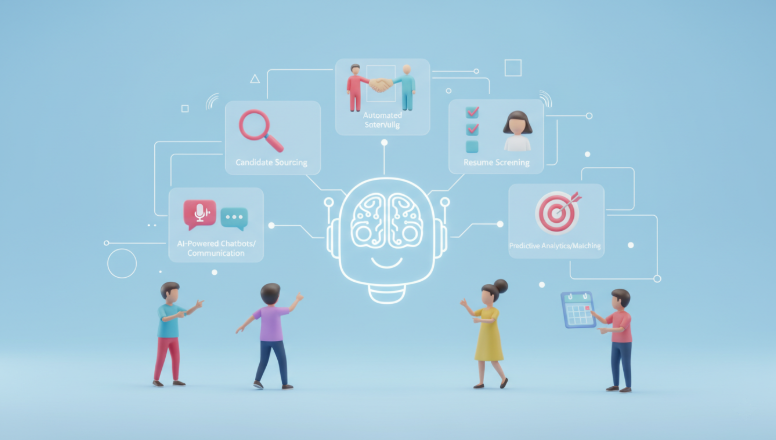
Use Case 1: AI-Powered Candidate Sourcing at Scale
Sourcing is one of the most time-consuming parts of recruitment.
Recruiters manually search job boards, databases and professional networks, often revisiting the same profiles repeatedly. This limits reach and slows response time.
With AI in staffing, sourcing becomes proactive instead of reactive.
AI-powered systems scan large datasets across platforms to identify candidates who match role requirements based on skills, experience and career trajectory. This includes passive candidates who may not be actively applying but are highly relevant.
The result is:
- Wider talent pools
- Faster shortlists
- Better alignment between role needs and candidate capability
This is one of the earliest areas where predictive talent matching starts delivering value.
Use Case 2: Intelligent Resume Screening and Shortlisting
Resume screening is where most bottlenecks quietly form.
Manual review introduces inconsistency. Two recruiters may shortlist very different profiles for the same role. Bias, fatigue and time pressure all influence decisions.
AI-driven screening uses natural language processing to analyse resumes contextually. Instead of matching keywords, it identifies transferable skills, relevant experience and role alignment.
This improves:
- Screening speed
- Shortlisting accuracy
- Fairness and consistency
When used correctly, AI in staffing supports recruiters by narrowing focus to the most relevant profiles, not by making final decisions.
Use Case 3: Predictive Talent Matching and Retention Forecasting
Hiring does not end at placement. One of the biggest costs for clients is early attrition. Traditional staffing focuses on filling roles, not predicting long-term fit.
This is where data-driven staffing solutions change the conversation.
By analysing historical placement data, performance feedback and tenure patterns, AI models can estimate:
- Likelihood of role success
- Cultural alignment indicators
- Retention risk
This allows agencies to advise clients proactively, not reactively. Over time, AI hiring trends in 2026 are shifting staffing from transactional placements to outcome-based partnerships.
Use Case 4: Candidate Engagement and Drop-Off Reduction
Candidate drop-off is one of the most underestimated problems in recruitment.
Long application processes, delayed responses and unclear next steps cause strong candidates to disengage quietly.
AI-driven chatbots and communication tools address this gap by:
- Providing instant responses to candidate queries
- Scheduling interviews automatically
- Sending timely updates and reminders
This does not replace human interaction. It ensures candidates are not left waiting unnecessarily.
Agencies using AI in staffing consistently see improved candidate experience and higher completion rates across hiring stages.
Use Case 5: Workforce Intelligence and Client Advisory
One of the most powerful but underused benefits of AI is insight.
Staffing analytics tools aggregate data across placements, industries, geographies, and skill sets. This enables agencies to provide clients with intelligence such as:
- Market salary benchmarks
- Skill demand trends
- Hiring lead-time forecasts
- Talent availability by region
In 2026, the most successful staffing agencies are not just filling roles. They are advising clients on workforce strategy using real data.
This is where AI recruitment technology elevates agencies from vendors to strategic partners.
Traditional Staffing vs AI-Driven Staffing Models
| Area | Traditional Staffing | AI-Driven Staffing |
| Sourcing | Manual searches | Automated, multi-source |
| Screening | Resume-by-resume | Context-aware analysis |
| Matching | Experience-based | Predictive models |
| Candidate engagement | Inconsistent | Continuous |
| Client insight | Limited | Data-driven |
This shift explains why AI in staffing is becoming a competitive differentiator, not a trend.
Why AI in Staffing Works Best with Human Expertise
There is an important truth that gets missed in many AI discussions.
Technology alone does not hire well.
AI excels at pattern recognition and scale. Humans excel at judgement, empathy and context. The strongest staffing models in 2026 combine both.
Recruiters still:
- Assess cultural nuance
- Build client trust
- Handle complex negotiations
- Coach candidates
AI removes friction so recruiters can focus on these high-value activities.
Best Practices for Adopting AI in Staffing Agencies
Agencies that succeed with AI in staffing tend to follow a few principles:
- Start with clear hiring problems, not tools
- Clean and connect existing data sources
- Keep humans involved in final decisions
- Measure outcomes, not activity
This ensures data-driven staffing solutions enhance performance without increasing risk or complexity.
The Future of AI in Staffing Beyond 2026
AI adoption in staffing will continue to deepen.
We will see:
- More advanced predictive talent matching
- Greater use of workforce planning analytics
- Stronger emphasis on ethical and explainable AI
- Tighter integration between ATS, CRM, and analytics platforms
What will not change is the need for human judgement. AI in staffing will support better decisions, not replace them.
Conclusion
Staffing in 2026 is no longer about working harder. It is about working smarter.
AI in staffing is helping agencies reduce delays, improve match quality, and deliver measurable outcomes for clients navigating uncertain labour markets.
Agencies that adopt data-driven staffing solutions thoughtfully will move beyond filling roles to shaping workforce success.
That is the real transformation happening now.
Leave A Comment