




|
Getting your Trinity Audio player ready...
|
ERP modernization with AI helps organisations move beyond static, transaction-focused systems toward smarter, more adaptive operations. By embedding AI into planning, forecasting and decision workflows, ERP systems become more responsive and insight-driven. When implemented with clear business goals and strong data foundations, AI-powered ERP delivers measurable improvements in efficiency, accuracy and decision-making.
ERP systems sit at the heart of most enterprises. Finance, supply chain, procurement, HR, operations. Everything flows through them.
And yet, many organisations are still running ERP systems that were designed for a very different world. Static workflows, manual reporting, heavy customisation and slow decision cycles.
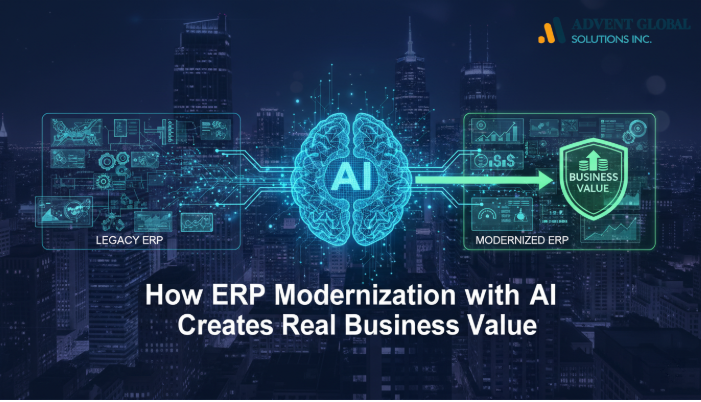
ERP modernization is no longer just about moving to a newer version or migrating to the cloud. What is changing the equation now is AI in ERP systems. When done right, artificial intelligence does not replace ERP. It unlocks value that traditional ERP could never deliver on its own.
Why Traditional ERP Systems Are No Longer Enough
Most legacy ERP platforms were built to record transactions, not to interpret them.
They do a good job of:
- Capturing data
- Enforcing process discipline
- Supporting compliance and controls
Where they fall short is insight and speed.
Business teams today expect systems to flag issues early, recommend actions, and adapt as conditions change. Static rule-based ERP workflows struggle in environments where demand shifts weekly, supply chains are fragile and customer behaviour is unpredictable.
This is where ERP modernization with AI becomes meaningful, not as a technology upgrade but as a business capability upgrade.
What ERP Modernization with AI Really Means
ERP modernization with AI is not about bolting a chatbot onto an old system.
It usually involves:
- Moving ERP platforms closer to real-time data environments
- Using machine learning to analyse historical and live ERP data
- Embedding intelligence directly into planning, forecasting and execution workflows
In simple terms, AI turns ERP from a system of record into a system of guidance.
Where AI Creates Tangible Business Value in ERP
The real test of any ERP initiative is whether it improves outcomes, not dashboards. Here are the areas where AI-powered ERP solutions consistently show value.
Smarter Forecasting and Planning
Traditional ERP forecasting relies heavily on historical averages and manual adjustments. AI models can process years of transaction data along with external signals such as seasonality, supplier performance and demand volatility.
This leads to:
- More accurate demand forecasts
- Better inventory positioning
- Reduced stockouts and overstocking
For supply chain and finance teams, this directly improves working capital and service levels.
Faster, Better Decision-Making
ERP systems generate massive volumes of data, but most of it goes underused. AI helps surface patterns that humans miss.
Examples include:
- Identifying cost anomalies early
- Flagging suppliers with rising risk
- Highlighting process bottlenecks before they escalate
This is where enterprise AI implementation inside ERP environments starts paying for itself.
Automation Beyond Rules
Classic ERP automation follows predefined rules. AI introduces context.
Instead of “if this, then that,” systems learn from outcomes. Invoice processing, exception handling, and procurement approvals become faster and more accurate without constant rule maintenance.
ERP Before and After AI: A Practical Comparison
| Area | Traditional ERP | AI-Enabled ERP |
| Forecasting | Historical averages | Predictive, adaptive models |
| Reporting | Static dashboards | Real-time insights |
| Exception handling | Manual review | Automated prioritisation |
| Decision support | Descriptive | Prescriptive |
| Process flexibility | Rigid | Adaptive |
This shift is why many organisations see ERP modernization as a strategic investment rather than an IT refresh.
Common Pitfalls in ERP Modernization with AI
Not every AI-driven ERP project succeeds. The failures are usually not technical.
Some common issues include:
- Poor data quality feeding AI models
- Lack of business ownership beyond IT
- Over-customisation that blocks scalability
- Unrealistic expectations of full automation
Successful ERP digital transformation balances technology with governance, process redesign, and user adoption.
How to Approach ERP Modernization the Right Way
The most effective ERP modernization programs tend to follow a few principles.
Start with business problems, not tools. AI should solve clear issues such as forecast accuracy, cycle time reduction, or cost leakage.
Modernise in phases. Core ERP stability comes first. Intelligence layers come next.
Keep humans in the loop. AI works best as decision support, not blind automation.
This approach ensures ERP AI integration delivers value without increasing risk.
Measuring the Business Impact of AI in ERP
Executives often ask a fair question. How do we measure success?
Some common metrics include:
- Reduction in forecast error
- Faster month-end close cycles
- Improved supplier performance
- Lower manual intervention rates
- Better inventory turns
When tracked consistently, these indicators show whether AI-driven ERP transformation is creating measurable value.
Final Thoughts
ERP systems are not going away. They remain critical to enterprise operations.
What is changing is the expectation placed on them.
ERP modernization with AI allows organisations to move beyond transaction processing toward insight-driven execution. It helps teams act faster, plan better, and respond with confidence in uncertain conditions.
The real value of AI in ERP is not intelligence for its own sake. It is clarity, speed, and resilience. For enterprises willing to modernise thoughtfully, that value is very real.
FAQs
- What is ERP modernization with AI?
ERP modernization with AI involves enhancing existing ERP systems with artificial intelligence to improve forecasting, automation and decision support, rather than simply upgrading software versions.
- How does AI add value to ERP systems?
AI helps ERP systems analyse large volumes of data, identify patterns, predict outcomes, and recommend actions, enabling faster and more informed business decisions.
- Do companies need to replace their ERP to use AI?
No. In most cases, AI is integrated into existing ERP platforms through modernisation layers, analytics tools, or cloud services.
- What business functions benefit most from AI in ERP?
Finance, supply chain, procurement, and operations typically see the strongest impact, especially in forecasting, planning, and exception management.
- What are the risks of ERP modernization with AI?
Common risks include poor data quality, lack of business ownership, and unrealistic automation expectations. These can be mitigated with phased implementation and governance.
Leave A Comment