




|
Getting your Trinity Audio player ready...
|
Enterprise cybersecurity is no longer just about stopping attacks. It is about keeping up.
Security teams today deal with an overwhelming volume of data. Logs from cloud systems, endpoints, identity platforms, SaaS tools, third-party vendors and internal applications never stop flowing. No matter how skilled a team is, there is a hard limit to how much humans can analyse in real time.
This is where AI entered enterprise cybersecurity.
Not as a magic fix. Not as a replacement for security teams. But as a way to scale decision-making when manual processes simply fall short.
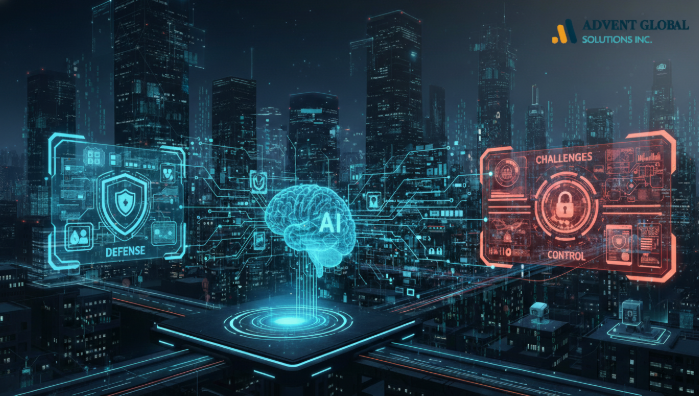
At the same time, AI brings its own risks. When intelligence increases, so does complexity. And in cybersecurity, complexity can be dangerous if it is not controlled.
This balance is what defines AI in enterprise cybersecurity today.
Why Enterprises Are Relying on AI for Cybersecurity
The main driver is not innovation. It is survival.
Modern enterprises generate millions of security events every day. Most of them are harmless. A few are critical. The challenge is separating the two fast enough.
AI helps security teams by:
- Identifying patterns humans would miss
- Reducing alert noise
- Highlighting high-risk activity earlier
- Supporting faster response decisions
That is why enterprise cybersecurity AI has become embedded into daily security operations rather than treated as an experimental capability.
Traditional Cybersecurity vs AI-Driven Cybersecurity
This comparison is where credibility starts to build.
| Area | Traditional Security Approach | AI-Driven Security Approach |
| Threat detection | Signature-based and rule-driven | Behaviour-based and anomaly-driven |
| Detection of new attacks | Limited | Stronger for unknown patterns |
| Alert handling | Manual triage | Automated prioritisation |
| Response speed | Slower | Faster with automation support |
| Analyst workload | High | Reduced but not eliminated |
This shift explains why AI cybersecurity solutions are now expected in large enterprises. They do not replace analysts. They help analysts focus on what actually matters.
Where AI Is Actively Used in Enterprise Cybersecurity
AI is already doing real work across security stacks, even if it does not always get labelled clearly.
Intrusion Detection and Prevention
AI-enabled systems analyse network traffic and system behaviour to detect anomalies. Unlike traditional tools, they can surface threats that do not match known attack signatures.
The trade-off is false positives, which is why tuning and human oversight remain essential.
Security Information and Event Management
Modern AI-driven SIEM platforms use machine learning to correlate events across different systems. Instead of flooding teams with alerts, AI helps prioritise incidents based on risk and context.
Incident Response Automation
AI supports automation by triggering predefined actions such as isolating systems, blocking suspicious activity, or escalating incidents. This reduces response time, especially during large-scale attacks.
What the Data Says About AI in Cybersecurity
Data is where trust comes from.
| Insight | Industry Observation |
| Faster breach detection | Organisations using AI detect breaches significantly earlier |
| Lower incident cost | AI-assisted response reduces investigation time and cost |
| Analyst efficiency | Teams handle more incidents with the same headcount |
| Reduced alert fatigue | Prioritised alerts improve decision quality |
These outcomes explain why AI is no longer positioned as optional. For many enterprises, AI in security operations is now a baseline capability.
The Risks Enterprises Must Acknowledge
AI does not only defend. It can also fail.
Model Manipulation
Attackers can deliberately attempt to influence AI models so that malicious behaviour appears normal. Without continuous monitoring, this risk grows quietly.
Explainability Challenges
Many AI systems function as black boxes. During audits or investigations, security teams may struggle to explain why certain decisions were made. This is a major concern for regulated industries.
Data Privacy Exposure
Security AI processes sensitive data. If training datasets are not properly anonymised, organisations risk compliance violations.
Over-Automation
Automation speeds things up, but mistakes scale just as quickly. An incorrect automated response can disrupt business operations more severely than the attack itself.
These challenges are why AI risk management in cybersecurity has become a board-level conversation.
What Responsible AI Use in Enterprise Cybersecurity Looks Like
Mature organisations treat AI as part of their security infrastructure, not as a shortcut.
| Area | Responsible Practice |
| Model performance | Regular testing and validation |
| Alert quality | Tracking false positives and false negatives |
| Data handling | Privacy-first data processing |
| Automation | Human approval for high-impact actions |
| Accountability | Clear ownership of AI decisions |
This approach builds trust internally and externally.
AI as a Strategic Enabler, Not a Silver Bullet
AI works best when it supports people, not replaces them. In real enterprise environments, cybersecurity decisions rarely sit in clean, predictable boxes. Context matters. Business impact matters. Timing matters.
Artificial Intelligence adds value by handling scale and speed. It helps analysts see patterns faster, surfaces weak signals that would otherwise be missed, and reduces noise during high-pressure incidents.
That space it creates is important. It allows security teams to focus on judgement, prioritisation, and decision-making rather than endless data sorting.
Enterprises that succeed with AI in enterprise cybersecurity understand this balance. They design AI systems to assist human expertise, not override it, and pair automation with clear governance and accountability.
Conclusion
AI has become a core part of enterprise cybersecurity. That is no longer up for debate. The volume, complexity, and pace of modern threats make purely manual approaches unrealistic.
What still matters is how AI is used. Organisations that rush adoption without controls often create new blind spots, whether through over-automation, unclear ownership, or poor data practices.
Those that slow down just enough to invest in quality standards, explainability, and accountability tend to see far better outcomes over time.
Cybersecurity has always been about staying one step ahead. AI raises the bar, but only for enterprises willing to use it responsibly and with discipline.
FAQs
1. What role does AI play in enterprise cybersecurity today?
AI helps enterprises detect threats faster, prioritise alerts, and respond more efficiently by analysing large volumes of security data that humans cannot process in real time.
2. Does AI replace human cybersecurity analysts?
No. AI supports analysts by reducing noise and highlighting risks, but human judgement is still essential for decision-making, investigation, and accountability.
3. What are the biggest risks of using AI in cybersecurity?
Key risks include false positives, lack of explainability, data privacy exposure, and over-automation without proper controls or oversight.
4. How can organisations use AI responsibly in cybersecurity?
By setting clear governance, testing models regularly, limiting automation for high-impact actions, and assigning ownership for AI-driven decisions.
5. Is AI necessary for enterprise cybersecurity going forward?
For most large organisations, yes. The scale and complexity of modern threats make AI-assisted security operations a baseline requirement rather than an optional enhancement.
Leave A Comment